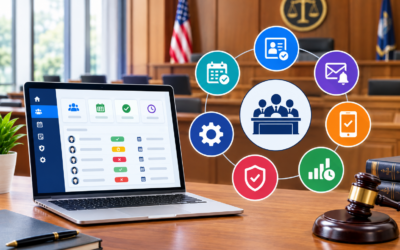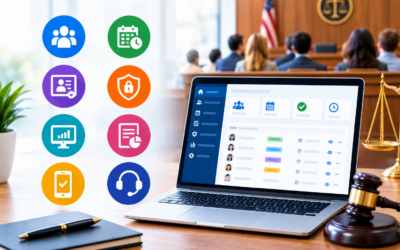
Traditionally, jury administration has involved a lot of paperwork, manual communication and coordination between court staff and jurors. As courts seek more efficient ways to handle these responsibilities, cloud technology is transforming the manner in which information is accessed and shared. With modern Jury Management Software, multiple administrative functions can be integrated into a connected digital environment instead of staff working across separate processes.
JuryQ supports this broader change with technology that connects the court experience with the juror experience.
From Paperwork to Digital Workflows
Forms, phone calls, emails, spreadsheets, printed notices and manual updates can all be part of the traditional jury process.
Individual tasks may look easy enough, but collectively they can create unnecessary admin work. Information may have to be entered twice, staff may have to follow up manually and it can take time to locate a particular record.
Cloud-Based technology revolutionizes this approach by providing a centralized digital environment for relevant information and workflows.
Why the Cloud Changes Accessibility
One of the major benefits of cloud technology is accessibility.
Court staff don’t have to depend on information found on one particular computer or in one physical location. Authorized users can access the system via supported devices and connections, depending on the platform’s design and security controls.
This is particularly helpful for courts that have numerous staff members engaged in jury administration.
Jurors can also benefit from access to significant information without relying solely on physical correspondence.
Communication Becomes More Connected
Jury duty is often about communicating in a timely manner.
Jurors need to receive clear explanations of reporting instructions, schedule changes, reminders and other information. Communicating in the traditional way can be very manual and uncoordinated, especially when information needs to be disseminated to large groups.
A Cloud-Based approach can enable digital notices and centralized communications to help court staff manage updates more efficiently.
It’s not just about automating communication. It is to make sure the right information is managed more easier and is easy to get to.
What Changes for Court Staff?
The move to the cloud can affect the day to day administrative work in several ways.
Instead of storing information in a variety of different files, staff might be able to work from one central system. Updates are easier to record, information can be retrieved faster and reporting is more accessible.
That doesn’t eliminate the need for human supervision. Rather, it can relieve staff of routine administrative work and enable them to devote more time to duties requiring judgment and attention.
What Changes for Jurors?
The juror experience is as important as administrative efficiency.
A digital system can provide jurors easier access to instructions, schedules, notifications and other information about their service. This can reduce uncertainty and make it easier for jurors to understand what they need to do.
For those who aren’t familiar with the court system, having information available through a simple digital interface can make jury service seem more manageable.
A More Connected Approach
Cloud technology can also link different aspects of the jury administration process.
Registration, communication, scheduling, attendance, reporting, and other functions functions do not have to be operated as isolated activities. Getting them into a connected environment can give court administrators better visibility into the process as a whole.
This broader connectivity can be an important consideration for courts evaluating Jury Duty Management System options.
Conclusion
The shift to Cloud-Based jury administration is part of a wider change in how courts are using technology. Centralized access, digital communication, streamlined workflows and increased visibility can help to ease some of the administrative challenges associated with traditional jury management.
A well-designed Jury Duty Management System can help bring court processes and juror interactions into a more organized digital environment. Modern Jury Management Software can provide the foundation for this more connected approach.
JuryQ supports this evolution by focusing on connecting courts and jurors through technology. When courts evaluate a move to the cloud, they are not simply asking themselves whether a platform is contemporary, but whether it can make jury administration more efficient, accessible, secure and manageable for all parties.